 Looksrare
Looksrare royalties depend on creator-fee settings even when ERC-2981 supplies a recipient
Last updated:Looksrare royalties are NFT creator fees, set at 0% in V2’s documented configuration alongside a separate 0.5% protocol fee. ERC-2981 supplies a recipient and requested royalty amount, while the completed trade’s payment records establish whether the recipient actually receives funds.
Creator-fee settings connect recipient information to settlement
The NFT contract or royalty registry identifies a potential recipient, while the exchange’s creator-fee manager determines the amount that settlement includes. These components answer different questions: who the collection designates, how the exchange calculates creator fees, and what the sale actually pays. A collection can publish royalty information even when an exchange applies no creator payment. NFT trading supplies the sale price that a royalty calculation needs; a transfer of NFT ownership alone supplies no such price.
Looksrare V2 separates the creator-fee manager from the core exchange. The exchange owner can replace that manager, so the available manager implementations do not establish which one governed a particular sale.
An unset creator-fee manager leaves the creator amount at zero in V2’s execution logic.
V2 removed the earlier creator rebate
The October 27, 2022 policy replaced default creator royalties with fee sharing, while allowing buyers to add an optional royalty payment. Under the new sale strategies, the creator allocation was 25% of the 2% total fee, equivalent to 0.5% of the sale price. Collections needed a receiving address through the royalty registry or ERC-2981 to receive that allocation. Without a recipient, the total protocol fee fell to 1.5%. These figures describe that historical arrangement.
V2 launched on April 6, 2023, with a 0.5% protocol fee and removed creator rebates at launch. V2’s documented fee configuration specifies a 0% creator fee. The older creator allocation and V2’s protocol fee therefore have different recipients despite sharing the same percentage.
What does ERC-2981 return for an NFT sale?
ERC-2981 returns a recipient address and a royalty amount for a particular token ID and sale price through royaltyInfo(tokenId, salePrice). The collection contract supplies the implementation. A direct lookup needs the collection’s contract address, the relevant token ID, and a price expressed in the sale currency’s units. The result identifies the address that the contract designates for that item and the amount that it requests for that price.
ERC-165 interface detection exposes ERC-2981 support through supportsInterface(0x2a55205a). The interface identifier describes a capability; it does not certify the returned address’s human identity.
The read function returns payment information without transferring money or recording a completed royalty payment.
Sale prices and royalty amounts share currency units
The sale price passed to ERC-2981 and the returned royalty amount use the same monetary unit, including its smallest-unit representation. The function receives an integer price without a currency address, so it cannot independently recognize the asset or its decimals. Software must retain that context when displaying the result. An amount expressed in the smallest units can look much larger than its human-readable equivalent. Converting the price before the lookup, then interpreting the response in a different unit, produces an incorrect payment figure.
For a percentage-based implementation, the royalty equals the supplied price multiplied by the applicable fraction, subject to integer rounding. ERC-2981 permits rounding upward or downward when division leaves a remainder.
Registry precedence can change the selected recipient
The recipient returned directly by an NFT contract can differ from the recipient that Looksrare’s full-royalties manager selects for a trade. CreatorFeeManagerWithRoyalties consults RoyaltyFeeRegistry before falling back to ERC-2981 when the registry returns no recipient. The registry describes collection-level royalty information, whereas an ERC-2981 implementation can vary its response by token ID. A nonzero registry recipient therefore changes which information this manager uses, even when the NFT also supports the standard.
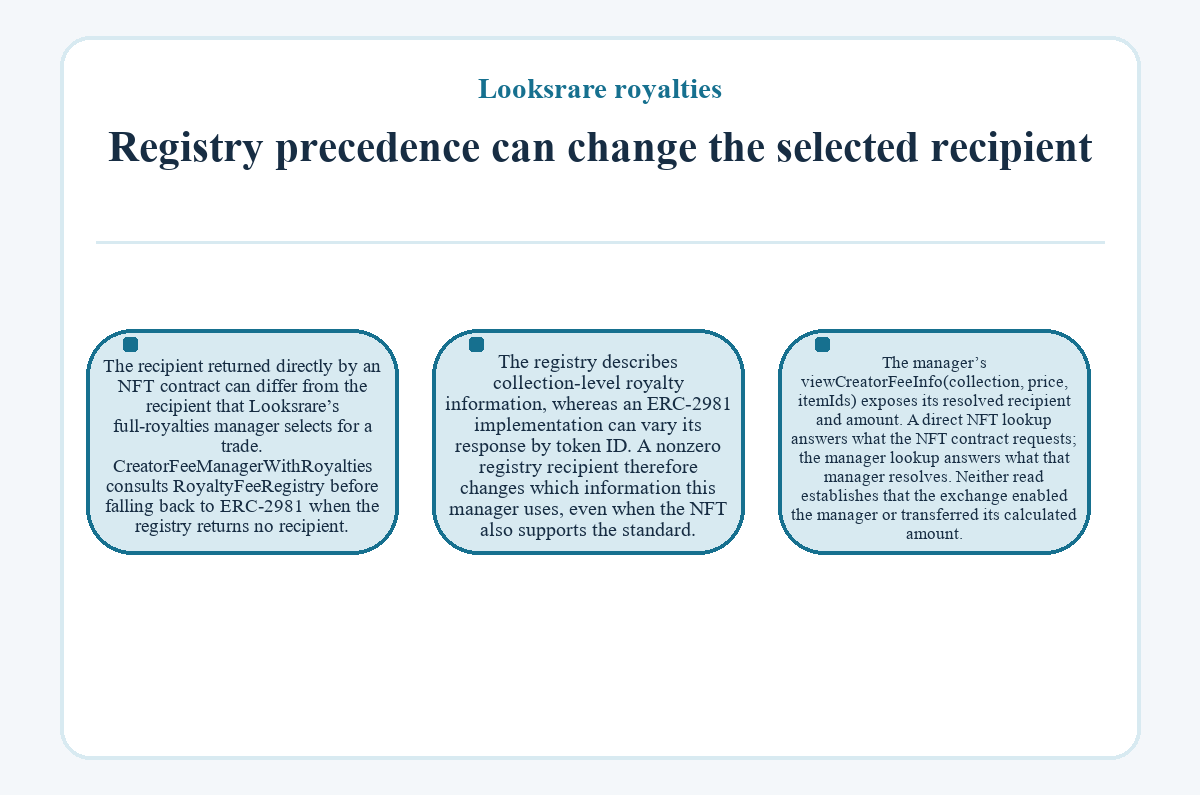
The manager’s viewCreatorFeeInfo(collection, price, itemIds) exposes its resolved recipient and amount. A direct NFT lookup answers what the NFT contract requests; the manager lookup answers what that manager resolves. Neither read establishes that the exchange enabled the manager or transferred its calculated amount.
Full royalties and fixed rebates calculate different amounts
CreatorFeeManagerWithRoyalties uses the royalty amount that the registry or eligible ERC-2981 lookup returns. CreatorFeeManagerWithRebates uses recipient information to calculate a fixed rebate instead. In the rebate implementation, STANDARD_ROYALTY_FEE_BP equals 50 basis points, or 0.5% of the transaction price. Its ERC-2981 branch reads the recipient and ignores the royalty amount returned by the NFT. A collection’s requested percentage therefore does not determine the rebate calculation. Both implementations first consult the registry, but they use the resulting information differently. These contracts describe available calculation models. Their presence does not mean that the zero-creator-fee V2 configuration pays either amount.
Execution-time settings explain changing royalty responses
Royalty information can change between order creation and execution when the collection implementation or registry permits updates. ERC-2981 also allows token-specific royalty calculations, so querying a different token ID can produce a different answer. A current response cannot establish the recipient or amount that applied to an older trade. Historical contract reads use the state associated with their selected block; they require a provider that can serve that state.
Keep the collection, token ID, sale price, and block context together when comparing responses. Changes within a block can require closer examination of the transaction’s execution, because a block-level read is not a snapshot of every intermediate operation.
Signing an order does not freeze external royalty settings that its execution later consults.
Reconciling a positive royalty quote with a zero creator fee
In this hypothetical case, a completed V2 sale involves an NFT whose contract returns a positive royalty amount.
The reader has the sale’s collection address, token ID, execution price, and transaction receipt. A royalty lookup for the relevant historical state returns a recipient and amount. Those inputs and responses belong to this hypothetical sale. The exchange’s execution-time configuration has no creator-fee manager, which leaves the creator amount at zero.
The reader decodes the sale event and finds a zero creator-fee amount. Examining the transaction’s currency transfers independently confirms that it sent no creator payment. The NFT changed ownership successfully, and the royalty quote remains positive, but the exchange did not include that requested royalty in this sale.
Changing today’s recipient settings cannot turn that completed sale into a royalty payment.
Bundle compatibility follows the selected fee manager
A bundle’s royalty requirements depend on the manager that the exchange actually invokes, with different checks for full royalties and fixed rebates. For an ERC-2981 bundle, the full-royalties manager queries each included token ID using the same transaction price. It rejects a bundle when the returned recipients or amounts differ. A collection name alone therefore cannot establish compatibility; token-specific royalty settings can differ within the same collection.
The rebate manager checks recipient consistency in its ERC-2981 branch while ignoring returned royalty amounts. Its fixed calculation makes those requested amounts irrelevant to that check. Registry-backed collection information follows the registry branch instead. These are conditions of the respective manager implementations, not a rule that every V2 purchase universally invokes ERC-2981.
Creator-fee limits can stop a royalty-enabled trade
A nonzero creator fee must fit the exchange’s configured percentage limit, even when the royalty manager successfully resolves its recipient and amount. The full-royalties manager itself does not cap an unusually high returned fee. V2’s execution logic applies the separate maxCreatorFeeBp limit against the transaction price and reverts when the fee exceeds it. The exchange owner can update that setting, with a maximum permitted setting of 25% in this implementation.
That upper bound describes what the owner can configure; it does not establish the live cap or the collection’s royalty rate. A successful manager lookup can therefore accompany a trade that fails its exchange-level fee check. Setting a royalty recipient alone cannot bypass this limit.
Completed transfers establish the creator payment
A successful sale establishes a creator payout only when its execution actually sends the relevant currency to the selected royalty recipient. V2 emits trade events containing the collection, traded items, currency, recipient addresses, and fee amounts. An NFT transfer proves the ownership change, while payment records establish the movement of sale proceeds. Token payments require the correct token contract’s transfer records. Native currency movements require transaction execution details. For ETH sales, also check WETH (wrapped ETH) transfer records: if the ETH transfer fails within its gas limit, V2 sends the amount as WETH to the same recipient. The transaction’s outer destination can be the exchange rather than the eventual payee.
The V2 event arrays place the creator recipient at feeRecipients[1] and the creator amount at feeAmounts[1]. The exchange transfers that amount when it is nonzero. In a zero-creator-fee sale, feeAmounts[1] records zero.
What to know about Looksrare royalties
Must I sign a message to read a Looksrare royalty recipient?
Reading a royalty recipient through a contract call does not require a wallet signature. A provider can execute royaltyInfo or viewCreatorFeeInfo as a read without submitting a transaction. A request to approve NFT transfers or sign an order serves a different purpose and is unnecessary for obtaining that read-only information.
Can a royalty recipient divide a payment among several wallets?
ERC-2981 returns a single recipient address, which can belong to a contract that handles further distribution. Any splitting rules belong to that receiving contract or its subsequent processes. Finding the recipient therefore does not establish the final beneficiaries, their shares, or whether the contract automatically forwards each incoming payment.
Does buying an NFT make me its royalty recipient?
ERC-2981 does not automatically assign royalties to the new NFT owner. The collection’s royalty implementation determines the recipient that the function returns. A custom implementation may connect recipient selection to ownership, but the standard does not require that behavior. Owning the token also does not by itself establish authority to edit the royalty registry.
Are LOOKS trading rewards a substitute for creator royalties?
LOOKS trading rewards were incentives for traders, separate from payments to a collection’s royalty recipient. That trading-rewards program ended in September 2023. Its historical calculations and claim instructions do not establish a creator payout for a later NFT sale, and receiving a trader reward did not prove that the collection received royalties.
What happens when the NFT contract’s royalty lookup reverts?
A reverted royalty lookup supplies no usable recipient or amount. In Looksrare’s fee-manager implementations, all failed ERC-2981 royaltyInfo calls can leave the creator amount at zero when the registry supplies no recipient. Mixed successful and failed calls within a bundle can instead trigger a rejection. This behavior concerns those implementations, not a universal rule for every marketplace.
Is ERC-2981 royalty lookup compatible with ERC-1155 NFTs?
ERC-1155 NFTs can implement the same ERC-2981 royalty interface as ERC-721 NFTs. Supporting the NFT token standard alone does not establish royalty support; the collection must also implement the royalty interface. The lookup accepts a token ID and sale price, with no separate ERC-1155 signature for retrieving its recipient and amount.
Will updating a royalty recipient recover an earlier payment sent elsewhere?
Updating royalty settings cannot move funds that a completed transaction already delivered to another address. Any onward transfer requires control of that account or an operation that its receiving contract permits. A recipient update can affect later lookups where the implementation supports it, but ERC-2981 provides no mechanism for reversing an earlier payment.