 Looksrare
 Looksrare community raffle hosts deposit ERC-721 prizes before entry sales open
Last updated:Looksrare community raffles connect deposited ERC-721 NFTs with paid entry tiers and a minimum ticket target on Ethereum. The host sets the prizes and ticket terms before entry sales open. Website eligibility covers NFTs from verified collections under the January 11, 2024 community-hosting rules. Raffle V2 coordinates drawing, prize claims, and host payouts through separate contract operations. Draw completion requires a responding randomness service; the original VRF v2 dependency is deprecated.
The prize pool, entry tiers, and draw target
The host’s prize pool defines what winners receive, while entry pricing and the sales target determine when the contract requests a draw. Each pricing option specifies a bundle of entries and its total price. The minimum entry count supplies the draw threshold, and the cutoff stops further purchases. A separate participant limit restricts how many entries an address can receive.
Entry purchases add chances to the raffle’s recorded ticket pool. The deposited NFTs remain in contract custody while ticket sales and drawing proceed. Winning entries establish who can claim each prize; they do not transfer the NFT immediately.
Which NFTs qualify for community hosting?
The January 11, 2024 community-hosting rules accepted ERC-721 NFTs from collections that Looksrare had verified. The token standard and the collection’s eligibility are separate conditions. ERC-721 tracks individually identifiable NFTs through a collection contract and token ID. Matching artwork or a familiar collection name does not establish that an item has the same contract identity. The prize selection must identify the actual token that the host intends to deposit.
Raffle V2 permits up to 200 prizes and 200 winner allocations per raffle. The minimum entry target must also be at least the number of winner allocations. Each ERC-721 prize represents one NFT allocated to one winner. Several NFTs from the same collection still occupy separate prize entries. The creator must hold the NFTs that the creation call transfers from their address.
Approvals and the prize deposit
Raffle V2 uses a Transfer Manager to move ERC-721, ERC-1155, and ERC-20 prizes from the creator into the raffle contract during creation. The host authorizes that manager at the token contract and grants the raffle contract permission to request transfers through it. An ERC-721 approval can cover an individual token or all the holder’s NFTs in that collection, depending on the authorization that the holder grants.
The V2 creation call deposits the specified prizes and records the raffle’s settings together. Successful execution opens the raffle to entries. A failed prize transfer reverts that creation transaction, so authorizing transfers alone does not establish that the raffle opened. Ethereum still charges for computation that an included, reverted transaction consumed.
Bundle prices and host proceeds
Hosts can define one to five pricing options in Raffle V2, each specifying the number of entries in a bundle and its total price. The first option must have a positive price, and its entry count must divide the minimum target evenly. Later options contain more entries and cost more in total. Each later option’s entry count must be a multiple of the first option’s entry count. Its total price, expressed in the payment currency’s smallest units, must divide evenly by its entry count. Their price per entry must be no higher than the preceding option’s price per entry. A larger bundle can therefore lower the unit cost without promising a prize.
The January 11, 2024 community raffle terms listed a 5% charge on total raffle proceeds. The applicable deduction follows the fee that V2 saves in the raffle’s configuration at creation. Creation rejects a proposed fee that differs from the contract’s configured rate, so the host must agree to that rate. The mix of purchased bundles determines gross entry receipts, and the stored fee determines the protocol deduction. Marketplace royalties concern a separate trading payment; they do not set this raffle percentage. Gas pays for Ethereum transaction execution and adds a separate expense to prize funding, entries, and claims.
Prize formats and draw options
The website’s community prize selection covers a narrower range than the underlying protocol. V2 also offers different entry-target settings, with conditions that affect the final accepted purchase.
| Prize or draw option | Eligibility, custody, or execution limit |
|---|---|
| Website ERC-721 prizes | The community-hosting guide, updated January 11, 2024, lists Looksrare-verified collections as eligible; prizes enter contract custody before sales open. |
| Protocol ERC-1155 prizes | V2 accepts token quantities deposited for the specified winner allocations. |
| Protocol ETH prizes | Creation must supply the native funds needed for every specified allocation. |
| Protocol ERC-20 prizes | V2 requires an allowed currency and authorization for the Transfer Manager to collect it. |
| Fixed entry target | V2 rejects a purchase that would exceed the configured total entry target. |
| Flexible entry target | The final purchase may cross the threshold; Drawing then stops further entries. |
| Below-target draw after cutoff | The host can request it only when sold entries cover every planned winner allocation. |
| Hosting scope | Protocol prize support does not expand the community interface’s accepted collection list. |
The threshold closes entries and requests randomness
The purchase that reaches the target moves a V2 raffle from Open to Drawing and requests randomness. That state change stops further entry purchases. Chainlink VRF, a verifiable random function, supplies a random value with a cryptographic proof. Chainlink VRF verifies the randomness proof onchain before a consuming application can use the value. Prize assignment also depends on the raffle’s recorded entry pool and winner allocations.
The callback records the random value and changes the raffle to RandomnessFulfilled. A subsequent winner-selection call assigns prizes and moves it to Drawn. A randomness request alone therefore does not establish a finished draw or an available prize claim.
Winner claims and the host payout
Once V2 records the winners, each winning recipient can claim the prize attached to their winning entry. The contract checks the caller and whether that prize has already been claimed. It supports individual claims and batched prize claims. The transfer moves the awarded asset from raffle custody to the authorized winner, and the claim record prevents a second withdrawal of the same allocation.
The host payout has its own operation after winner selection. It transfers entry proceeds less the raffle’s stored protocol fee to the creator and marks the raffle Complete. Eligible winners can continue claiming outstanding prizes in that state. Complete describes the host’s settlement; it does not mean that every winner has already collected an NFT.
What happens when the entry target is missed?
After the cutoff, the host can request a below-target draw or cancel the raffle, subject to V2’s state and entry-count conditions. Reaching the deadline stops purchases without automatically returning deposits.
A below-target draw requires enough sold entries for every planned winner allocation. V2 rejects a draw with no entries or fewer entries than winners.
Cancellation moves an Open raffle to Refundable. During the first hour after its cutoff, only the raffle owner can initiate this cancellation. After that interval, V2 permits other callers to initiate it. Ticket payers can claim their recorded entry payments once the refund state applies. That repayment covers the entry amount, while the gas that earlier transactions consumed remains a separate expense.
The prize withdrawal returns the deposited pool to the creator and changes the state to Cancelled. Refund claims remain available in both Refundable and Cancelled. V2 also supports applying eligible refunds toward new entries through a rollover, provided the payment currencies match.
Version limits and stalled draws
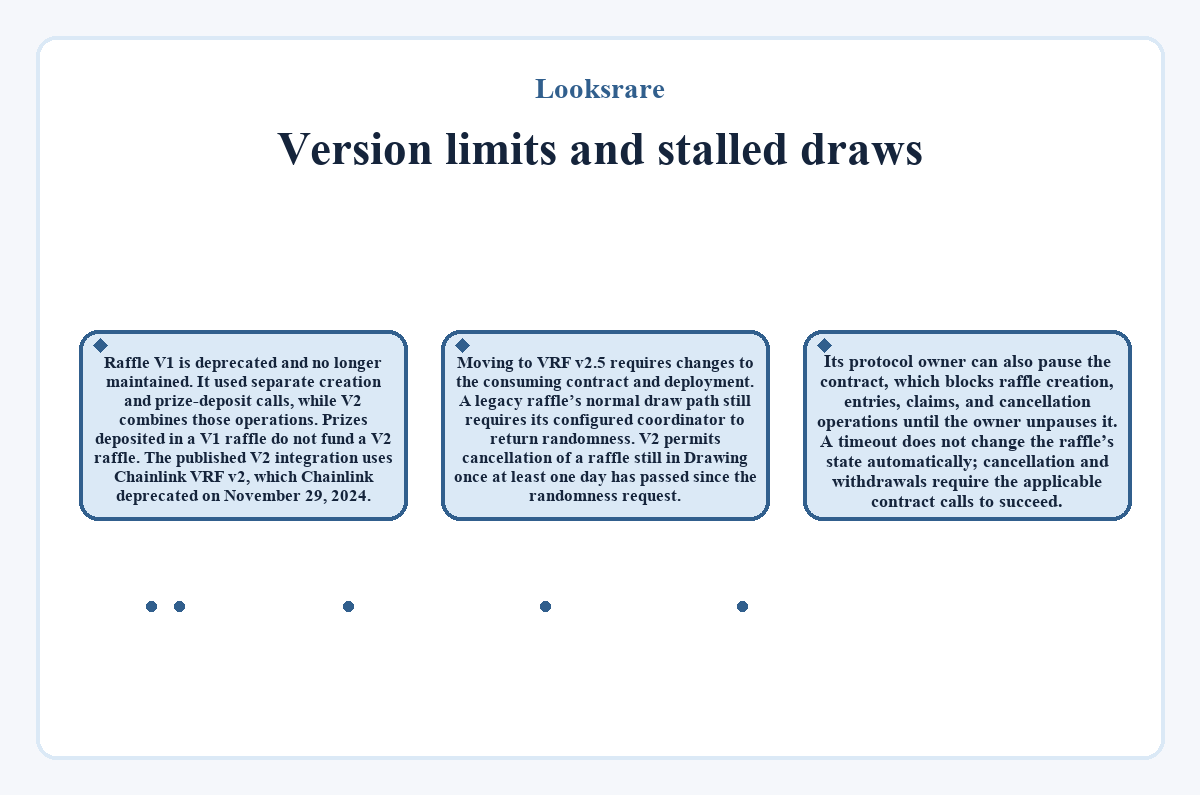
Raffle V1 is deprecated and no longer maintained. It used separate creation and prize-deposit calls, while V2 combines those operations. Prizes deposited in a V1 raffle do not fund a V2 raffle.
The published V2 integration uses Chainlink VRF v2, which Chainlink deprecated on November 29, 2024. Moving to VRF v2.5 requires changes to the consuming contract and deployment. A legacy raffle’s normal draw path still requires its configured coordinator to return randomness.
V2 permits cancellation of a raffle still in Drawing once at least one day has passed since the randomness request. Its protocol owner can also pause the contract, which blocks raffle creation, entries, claims, and cancellation operations until the owner unpauses it. A timeout does not change the raffle’s state automatically; cancellation and withdrawals require the applicable contract calls to succeed.
Everyday questions about Looksrare
Can raffle entries be assigned to another wallet?
Raffle V2 supports an entry recipient that differs from the wallet paying for the tickets. Its recipient field determines the address attached to the entries and any winning allocation. When no alternate recipient is specified, the caller receives the entries. This is a contract capability, not a promise that every interface exposes the option.
Which wallet receives a refund for delegated entries?
Raffle V2 returns a cancelled entry payment to the payer, even when another wallet received the entries. It tracks the amount paid against the purchasing address. The delegated recipient’s ability to claim a winning prize is a different entitlement, so receiving entries does not transfer ownership of the payer’s potential refund.
How does the participant cap apply to entries bought for another recipient?
Raffle V2 applies the configured participant cap to the address receiving the entries. Purchases from different paying wallets accumulate toward that recipient’s entry count. Changing the payer therefore does not reset the recipient’s allowance under the raffle’s cap. Payment accounting separately records who supplied the funds.
Will one wallet be able to win several prizes in a raffle?
One wallet can receive several prizes when it holds different winning entries. V2 avoids selecting the same entry twice, rather than excluding an address after its first win. Each winning allocation has its own claim record. Holding multiple entries creates that possibility without establishing that any particular wallet will win.
How far ahead may a host set the raffle cutoff in V2?
Raffle V2 requires a cutoff between one day and one week after the block timestamp at creation. The cutoff closes entry purchases; it does not promise a completed draw at that time. A raffle that reaches its target can request randomness earlier, while a missed target leaves post-cutoff settlement choices.
Must batched entries for different raffles use the same currency?
A Raffle V2 entry batch requires all included raffles to use the same payment currency. The contract rejects a currency mismatch within that call. Each included raffle also retains its own cutoff, entry target, and participant limit, so matching currencies does not remove those purchase conditions.
When does a rollover require an additional entry payment?
A V2 rollover collects an additional payment when the chosen entries cost more than the eligible refund balance. It returns excess funds when the refund exceeds that cost. All refund sources and destination entries must share the same fee currency, and the destination raffle must accept the entry purchase under its own limits.
Does depositing an NFT prize freeze its artwork or metadata?
Depositing an ERC-721 prize changes token custody without automatically making its metadata immutable. The collection’s own implementation determines whether metadata can change. The contract address and token ID identify the awarded NFT, while its displayed artwork can depend on metadata that the collection controls.